
Is raw feeding safe? Parasites, bacteria, and the three questions you should ask
Safety doesn't come from adjectives — it comes from how things are done. Our answers to the three real risks of raw feeding, plus three questions you can ask any brand. Including us.
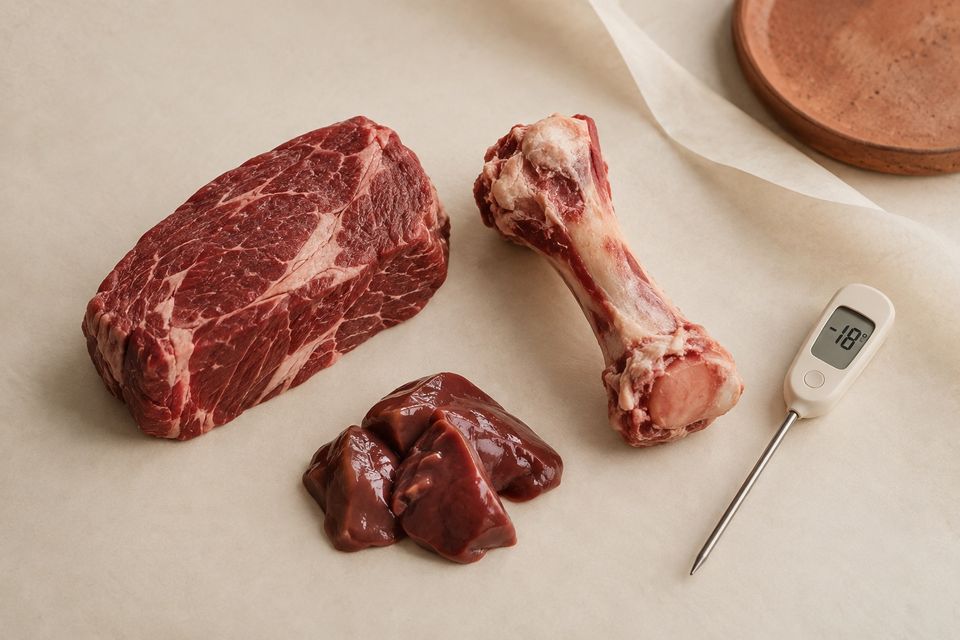
Since you clicked on this, you probably already have half an answer.
You want to feed your pet better — but the word “raw” makes people uneasy. That unease is right. It isn't an obstacle; it's a standard. Anything that goes into a body deserves to be questioned seriously.
We're not going to win you over with words like “natural” or “ancestral.” Safety doesn't come from adjectives — it comes from how things are done. Here are our answers to three real risks, and — more importantly — three questions you can take to any brand. Including us.
Risk one: parasites
Parasite risk comes mainly from the ingredients themselves, not from “raw” as a way of feeding.
Control has three layers: meat sourced with inspection certificates; proper freezing of high-risk ingredients (parasites and their eggs are killed after enough days below -18°C — standard practice in the seafood and raw-food industries); and staying away from high-risk cuts entirely.
So the question isn't whether raw feeding carries parasite risk — it's whether you can see where this meat came from and how it was handled. If you can't see it, don't feed it.
Risk two: bacteria
Salmonella, E. coli — these are real, and a brand that avoids the topic isn't worth your trust.
Control comes down to three things: an unbroken cold chain for ingredients (≤4°C, from slaughter to packing); food made the same day and delivered within the week, leaving bacteria no time to multiply; and portions designed around how much your pet actually eats, so there's no leftover sitting overnight.
To be honest about the limit: pets with weaker immunity — the young, the old, the unwell — are more sensitive to bacteria. If your pet is in one of those stages, ask your vet first, then decide what to feed. We make food, not medicine.
Risk three: nutritional imbalance
This is the quietest of the three risks, and the most common. A long-term “chicken breast only” version of raw feeding goes wrong more reliably than bacteria ever will — calcium-to-phosphorus ratios drift, trace minerals go missing, and the damage is slow.
8:1:1 is a common starting reference (roughly 80% muscle meat, 10% bone, 10% organ), but ratios are only a starting point. Age, weight, body condition, allergy history — when these differ, the recipe should differ. That's why we make “one pet, one meal”: not the same bag in new packaging, but a recipe calculated for each animal individually.
Three questions you can take to any brand
- Where does the meat come from — and can you see the inspection and batch records?
- From the kitchen to my door, how are temperature and time controlled?
- Who sets the recipe, and on what basis? A person? A nutritionist? Or the phrase “scientific formula”?
If any brand — including us — can't answer one of these, you have your answer.
Finally
You already treat them as family — that's why you're asking these questions. That small unease of yours is right. Keep it.
If you'd like to see what a meal calculated for your pet looks like — two minutes to build their profile. Every recipe is reviewed by a nutritionist: the technology does the calculating; a person makes the call.
This article shares feeding knowledge and is not medical advice. For health concerns, see your vet.