
Making your own cat food: where the difficulty actually is
Homemade cat food isn't hard because of love — it's hard because of three things: ratios, ingredients and storage, and the most underestimated one, consistency.
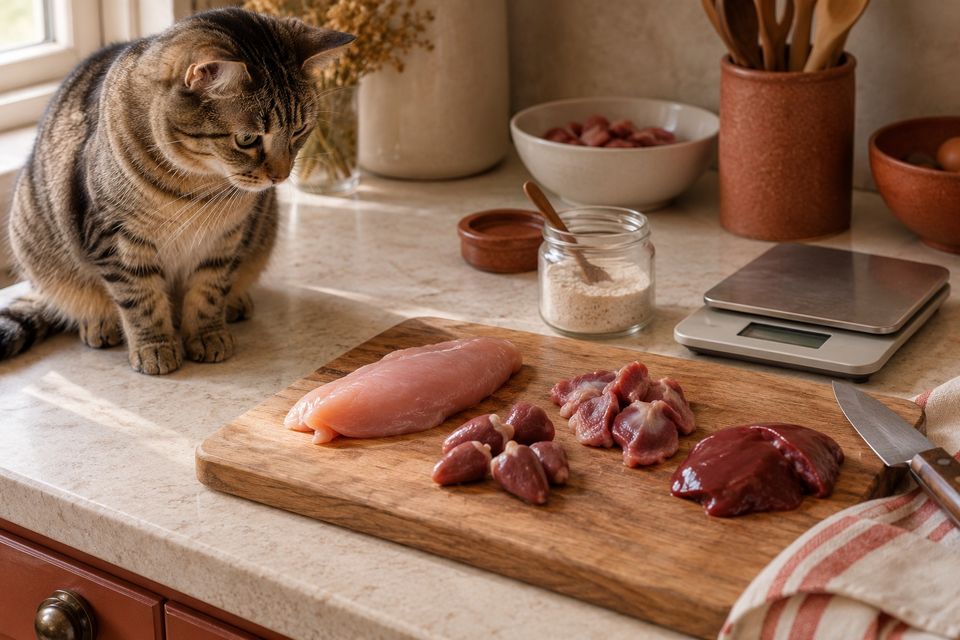
Anyone willing to cook for their cat has already cleared the attitude hurdle.
But between “having cooked cat food” and “cooking it right, every time, for years” sit three things. Laying them out honestly isn't a deterrent — quite the opposite: the people who know where the difficulty is are the ones most likely to actually get it right.
The first thing: the ratios
Cats are obligate carnivores — yet “just feed meat” is precisely the most common mistake in homemade cat food.
- Taurine. Cats can't synthesize enough taurine on their own; it has to come from food. Chronic deficiency hits the heart and the retinas first — and it's nearly invisible early on. Taurine lives mainly in organ meats like hearts and gizzards; no amount of lean muscle meat will cover it.
- The calcium-to-phosphorus ratio. Muscle meat is high in phosphorus and low in calcium, so a meat-only diet inverts the ratio. The 8:1:1 framework common in raw-feeding circles (meat : bone : organs) exists to put the calcium back — but “bone” is the hardest element to pull off in a home kitchen. Sourcing bones, grinding bone meal: real work.
- Liver. Liver is nutrient-dense, but it's also high in vitamin A — too much and you overshoot, too little and the diet falls short. The framework is 8:1:1; get the proportions slightly wrong and the whole thing tips the wrong way.
A framework is not a recipe. Even at the same 8:1:1, a growing kitten and a seven-year-old cat need different energy density and different nutritional emphasis.
The second thing: ingredients and storage
The ingredient bar for homemade cat food isn't on the supermarket shelf — it's in the supply chain: the meat source needs to be reliable and traceable, and the cold chain can't break anywhere along the way.
Buying fresh and cooking the same day is the surest route. Want to cook a week at a time? Then you're freezing — and freezing, thawing, and portioning are each variables you now have to manage. Food for your cat should be managed to the standard you'd apply to your own, if not higher: your cat won't tell you that today's meat smells slightly off.
The third thing: consistency
This is the most underestimated one. Cat food isn't something you cook once — it's every week, for years. Late nights at work, business trips, going home for the holidays: the supply can't stop.
Most homemade plans don't die from being done wrong. They die from exhaustion. Enthusiasm peaks in month one; by month three it's “let's just cover this week with kibble” — and one stopgap becomes the norm. Yet your cat's nutrition loses precisely to that stop-start pattern: three weeks of correct ratios, a week off, then back again — and the gut has to readjust each time.
Honestly
If you have the time and the willingness to learn, homemade cat food can absolutely be done well — take your recipe to a vet or pet nutritionist, review it against your cat's condition every few months. That road is open.
If where you're stuck is the third thing — not that you can't, but that you can't do it consistently for years — that's exactly the problem a fresh-food service exists to solve: the recipe is modeled around your cat's profile and reviewed by a nutritionist, cooked fresh each week, delivered cold to your door. The technology does the calculating; a person makes the call.
If you'd like to see what a meal built from your cat's age, weight and body condition looks like — two minutes to build their profile.
And once the recipe is set, the first week of switching has its own rules: The first week: a 7–14 day transition plan, and the three signals to watch.
This article shares feeding knowledge and is not medical advice. For health concerns, see your vet.